SECTION 1Identification
| Product identifier | Thunderbolt |
| Other means of identification | Isopropyl alcohol; isopropanol; 2-propanol; IPA; dimethyl carbinol. CAS No. 67-63-0. Product code TB-1985. |
| Recommended use | Industrial solvent and raw material for formulating cleaning products. |
| Restrictions on use | Industrial use only. Not for medical, food or drug use. Not for resale to consumers. |
| Supplier (U.S.) | Kaer Morhen Chemical Supply Co. 1 Wolf School Road, Kaedwen Valley Main office: (555) 555-0191 Regulatory contact: G. Rivia, Product Stewardship |
| Emergency telephone | (555) 555-0188, 24 hours (Kaer Morhen emergency line). In a medical emergency, call 911. |
SECTION 2Hazard identification
Classification (29 CFR 1910.1200(d))
- Flammable liquids, Category 2
- Serious eye damage/eye irritation, Category 2A
- Specific target organ toxicity, single exposure, Category 3 (narcotic effects)
Label elements
Signal word: DANGER Hazard statements:
| 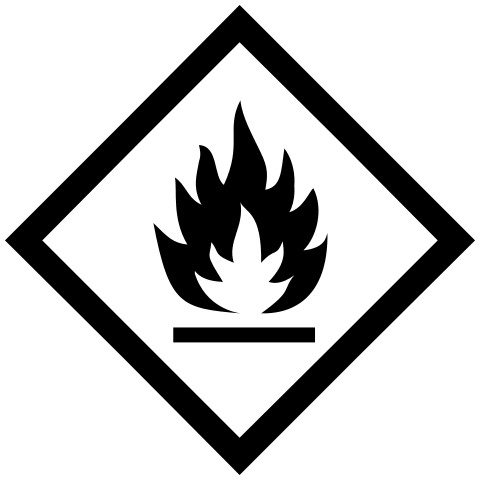  Flame | Exclamation mark |
| Precautionary statements: Prevention | Keep away from heat, hot surfaces, sparks, open flames and other ignition sources. No smoking. Keep container tightly closed. Ground and bond container and receiving equipment. Use explosion-proof electrical, ventilating and lighting equipment. Take action to prevent static discharge. Avoid breathing vapors. Use only outdoors or in a well-ventilated area. Wash hands thoroughly after handling. Wear protective gloves, eye protection and face protection. |
| Response | If on skin (or hair): Take off immediately all contaminated clothing. Rinse skin with water or shower. If inhaled: Remove person to fresh air and keep comfortable for breathing. Call a poison center or doctor if you feel unwell. If in eyes: Rinse cautiously with water for several minutes. Remove contact lenses, if present and easy to do. Continue rinsing. If eye irritation persists: Get medical attention. In case of fire: Use alcohol-resistant foam, dry chemical or carbon dioxide to extinguish. |
| Storage | Store in a well-ventilated place. Keep cool. Keep container tightly closed. Store locked up. |
| Disposal | Dispose of contents and container in accordance with federal, state and local regulations (see Section 13). |
| Hazards not otherwise classified | None identified. |
| Hazards classified under 1910.1200(d)(1)(ii) (reaction products) | None identified for the recommended use. |
| Ingredients of unknown acute toxicity | Not applicable. This product is a single substance. |
SECTION 3Composition/information on ingredients
Substance.
| Chemical name | Common name and synonyms | CAS No. | Concentration (wt %) |
|---|---|---|---|
| Propan-2-ol | Isopropyl alcohol; isopropanol; 2-propanol; IPA | 67-63-0 | 99.5 minimum |
| Water | Water | 7732-18-5 | 0.5 maximum |
Impurities and stabilizing additives: none that are classified or contribute to the classification.
SECTION 4First-aid measures
| Inhalation | Move the person to fresh air. If breathing is difficult, trained personnel give oxygen. If not breathing, give rescue breathing. Get medical attention if symptoms persist. |
| Skin contact | Take off contaminated clothing (it is flammable when wet). Flush skin with water. Get medical attention if irritation develops. |
| Eye contact | Rinse immediately with water for at least 15 minutes, holding eyelids open. Remove contact lenses if easy to do. Get medical attention if irritation persists. |
| Ingestion | Do not induce vomiting. Rinse mouth. Get medical attention immediately. Never give anything by mouth to an unconscious person. |
| Most important symptoms and effects, acute and delayed | Irritation of eyes, nose and throat; drowsiness, dizziness and headache; dry, cracked skin from repeated contact. Ingestion causes central nervous system depression. |
| Immediate medical attention and special treatment | Treat symptomatically. For ingestion, get medical attention immediately. |
SECTION 5Fire-fighting measures
| Suitable extinguishing media | Alcohol-resistant foam, dry chemical, carbon dioxide. Water spray or fog to cool containers and knock down vapors. |
| Unsuitable extinguishing media | Solid (straight) water stream. It can scatter and spread the fire. |
| Specific hazards | Highly flammable. Vapor is heavier than air (relative vapor density 2.1) and can travel along the ground to an ignition source and flash back. Containers can rupture when heated. Burns with a pale, almost invisible flame in daylight. Combustion products: carbon monoxide and carbon dioxide. |
| Special protective equipment and precautions for fire-fighters | Positive-pressure self-contained breathing apparatus (SCBA) and structural fire-fighting gear. Cool fire-exposed containers with water from a safe distance. Keep fire-control water out of drains and waterways. |
SECTION 6Accidental release measures
| Personal precautions, protective equipment and emergency procedures | Eliminate all ignition sources. Evacuate the area and keep people upwind. Ventilate. Use non-sparking tools and grounded equipment. Wear the PPE in Section 8; for large spills or unknown vapor levels use SCBA. Responders follow the employer's emergency response plan. |
| Methods and materials for containment and cleaning up | Stop the leak if it can be done safely. Dike ahead of a large spill; keep out of storm drains, sewers and waterways. Absorb small spills with inert absorbent (dry sand, vermiculite, earth) and place in closed, labeled containers for disposal. Alcohol-resistant foam can be used to suppress vapors. |
SECTION 7Handling and storage
| Precautions for safe handling | Use only with adequate ventilation. Keep away from heat, sparks and open flames. Ground and bond containers and receiving equipment during transfer. Use explosion-proof equipment. Avoid contact with eyes. Do not eat, drink or smoke in work areas. |
| Conditions for safe storage, including incompatibilities | Store in tightly closed containers in a cool, well-ventilated area away from heat and ignition sources, in accordance with 29 CFR 1910.106. Keep away from strong oxidizers, acetaldehyde, chlorine, ethylene oxide, acids and isocyanates. Isopropyl alcohol can form peroxides on prolonged storage in contact with air; date containers and do not distill old stock to dryness. |
| Storage classification (29 CFR 1910.106) | Flammable liquid Category 2. |
SECTION 8Exposure controls/personal protection
Occupational exposure limits
| Ingredient (CAS) | OSHA PEL (Table Z-1) | NIOSH REL | ACGIH TLV | NIOSH IDLH |
|---|---|---|---|---|
| Isopropyl alcohol (67-63-0) | TWA 400 ppm (980 mg/m³) | TWA 400 ppm (980 mg/m³); STEL 500 ppm (1,225 mg/m³) | TWA 200 ppm; STEL 400 ppm; A4 | 2,000 ppm (based on 10% of LEL) |
| Appropriate engineering controls | General or local exhaust ventilation to keep airborne levels below exposure limits. Explosion-proof ventilation equipment. Eyewash in the work area. |
| Eye/face protection | Chemical splash goggles. Add a face shield where splashing is likely. |
| Skin protection | Chemical-resistant gloves (for example butyl rubber or nitrile); confirm breakthrough time with the glove manufacturer's data. Flame-resistant clothing where fire exposure is possible. Remove clothing that becomes wet with product (flammable). |
| Respiratory protection | Use under a written respiratory protection program meeting 29 CFR 1910.134. NIOSH: up to 2,000 ppm, any chemical cartridge respirator with a full facepiece and organic vapor cartridges (APF 50), or supplied-air respirator. Above 2,000 ppm or unknown concentrations: pressure-demand SCBA with full facepiece. |
SECTION 9Physical and chemical properties
| Physical state | Liquid |
| Color | Colorless |
| Odor; odor threshold | Odor of rubbing alcohol. Odor threshold (AIHA): mean detection 43 ppm; reported range 1 to 610 ppm. |
| Melting point/freezing point | -89.5 °C (-127 °F) |
| Boiling point | 181 °F (83 °C) |
| Flammability | Flammable liquid, Category 2 |
| Lower/upper flammability limit | LEL 2.0%; UEL 12.7% (at 200 °F) |
| Flash point | 53 °F (12 °C), closed cup |
| Auto-ignition temperature | 399 °C (750 °F) |
| Decomposition temperature | No data available |
| pH | Not applicable (neutral organic liquid) |
| Kinematic viscosity | About 2.6 mm²/s at 25 °C (calculated from dynamic viscosity 2.038 mPa·s and density 0.785) |
| Solubility | Miscible with water |
| Partition coefficient n-octanol/water (log Kow) | 0.05 |
| Vapor pressure; evaporation rate | 33 mmHg at 20 °C (68 °F); evaporation rate 1.7 (n-butyl acetate = 1) |
| Density/relative density | Specific gravity 0.785 at 20 °C (about 6.55 lb/gal) |
| Relative vapor density | 2.1 (air = 1) |
| Particle characteristics | Not applicable (liquid) |
SECTION 10Stability and reactivity
| Reactivity | Not reactive under normal conditions of use and storage. |
| Chemical stability | Stable. Can form peroxides on prolonged storage in contact with air. |
| Possibility of hazardous reactions | Vapors form explosive mixtures with air. Reacts violently with strong oxidizers. Forms explosive mixtures with hydrogen peroxide. |
| Conditions to avoid | Heat, sparks, open flames, static discharge, other ignition sources. |
| Incompatible materials | Strong oxidizers, acetaldehyde, chlorine, ethylene oxide, acids, isocyanates. |
| Hazardous decomposition products | Carbon monoxide and carbon dioxide when burned. Acrid smoke and fumes when heated to decomposition. |
SECTION 11Toxicological information
| Likely routes of exposure | Inhalation, ingestion, skin and eye contact. |
| Symptoms | Irritation of eyes, nose and throat; drowsiness, dizziness, headache; dry, cracking skin. In animals: narcosis. |
| Target organs | Eyes, skin, respiratory system, central nervous system. |
| Acute toxicity (numerical measures) | Oral LD50 (rat): 5,045 mg/kg Oral LD50 (rabbit): 6,410 mg/kg Inhalation LC50 (rat): 72.6 mg/L (72,600 mg/m³), 4 hours; 12,000 ppm, 8 hours Dermal: no numerical value reported here. Not classified for acute toxicity: values are above the Category 4 limits in Table A.1.1. |
| Skin corrosion/irritation | Not classified. Repeated contact defats the skin and causes dryness and cracking. |
| Serious eye damage/irritation | Category 2A. Causes serious eye irritation. |
| Respiratory or skin sensitization | Not classified. No data indicating sensitization. |
| Germ cell mutagenicity; reproductive toxicity | Not classified. |
| Specific target organ toxicity, single exposure | Category 3, narcotic effects (drowsiness, dizziness). |
| Specific target organ toxicity, repeated exposure; aspiration | Not classified. |
| Delayed, immediate and chronic effects | Acute: eye and respiratory irritation, central nervous system depression. Chronic: dermatitis from repeated skin contact. |
| Interactive effects | No information available. |
| Carcinogenicity | IARC: Group 3, not classifiable as to carcinogenicity to humans. (IARC classifies isopropyl alcohol manufacture using strong acids, a process, as Group 1; this does not apply to the product.) NTP Report on Carcinogens: not listed. OSHA: not regulated as a carcinogen. |
SECTION 12Ecological information
| Ecotoxicity | Low acute aquatic toxicity. Daphnia magna EC50 (24 h): 114 mM (about 6,850 mg/L). Crangon crangon LC50 (48 h): 1,400 mg/L. |
| Persistence and degradability | Biodegradable. 70% of theoretical oxygen demand in 20 days with municipal wastewater seed. |
| Bioaccumulative potential | Low. Estimated BCF 3 (log Kow 0.05). |
| Mobility in soil | Very high mobility (estimated Koc 1.5). Volatilizes from moist soil and water surfaces. |
| Other adverse effects | No information available. |
SECTION 13Disposal considerations
Unused product that is discarded is an ignitable hazardous waste, D001 (a liquid with a flash point below 60 °C (140 °F) that is not a solution containing less than 24 percent alcohol by volume and at least 50 percent water by weight, 40 CFR 261.21(a)(1)). Isopropyl alcohol is not a listed P or U waste. Manage under 40 CFR Parts 260 through 273 and state rules. Empty containers hold flammable residue and vapor; do not cut, weld or pressurize. Manage empty containers under 40 CFR 261.7.
SECTION 14Transport information
| UN number | UN1219 |
| UN proper shipping name | Isopropanol (or Isopropyl alcohol) |
| Transport hazard class | 3 |
| Packing group | II |
| Basic description (49 CFR 172.202) | UN1219, Isopropanol, 3, II |
| Environmental hazards | Not a marine pollutant (not listed in Appendix B to 49 CFR 172.101). Not a hazardous substance (no RQ under 40 CFR 302.4). |
| Transport in bulk (IMO instruments) | No information available. |
| Special precautions | Emergency Response Guidebook Guide 129. Special provisions IB2, T4, TP1. Packaging: 49 CFR 173.150 (exceptions), 173.202 (non-bulk), 173.242 (bulk). |
SECTION 15Regulatory information
| TSCA | Listed on the TSCA Inventory (active). |
| CERCLA (40 CFR 302.4) | Not a listed hazardous substance. No reportable quantity. |
| EPCRA 302 (40 CFR 355, Appendix A) | Not an extremely hazardous substance. |
| EPCRA 311/312 (40 CFR 370) | Hazardous chemical under the OSHA HCS. Reporting threshold 10,000 lb on site at any one time (40 CFR 370.10(a)(2)(i)). |
| EPCRA 313 (40 CFR 372.65) | Isopropyl alcohol is listed, but only for persons who manufacture it by the strong acid process, with no supplier notification. No supplier notification applies to this product. |
| Clean Air Act 112(r) (40 CFR 68.130) | Not a listed regulated substance. |
| OSHA Process Safety Management (29 CFR 1910.119) | Not listed in Appendix A. A process involving 10,000 lb or more of a flammable liquid with a flash point below 100 °F in one location is covered under 1910.119(a)(1)(ii), except as provided in (a)(1)(ii)(A) and (B). |
| OSHA flammable liquids (29 CFR 1910.106) | Category 2 flammable liquid. |
SECTION 16Other information, including date of preparation or last revision
| Date of preparation or last revision | March 3, 2025. Version 3.1. Supersedes October 14, 2022. |
| Revision note | Updated to the Hazard Communication Standard as amended May 20, 2024 (89 FR 44144) and corrected October 9, 2024 (89 FR 81829). |
| Abbreviations | ACGIH: American Conference of Governmental Industrial Hygienists. APF: assigned protection factor. BCF: bioconcentration factor. IDLH: immediately dangerous to life or health. LEL/UEL: lower/upper explosive limit. PEL: permissible exposure limit. REL: recommended exposure limit. STEL: short-term exposure limit. TLV: threshold limit value. TWA: time-weighted average. |