SECTION 1Identification
| Product identifier | Brilliance |
| Other means of identification | Product code BRL-1701. Ammoniated polish emulsion. |
| Recommended use | Surface polish for metal, glass and hard surfaces. Industrial and institutional use. |
| Restrictions on use | Do not mix with bleach, chlorine products or acids. Not for household use. |
| Manufacturer (U.S.) | Perry Industries, Inc. 1 Perry Parkway, New Mos Eisley Main office: (555) 555-0108 SDS prepared by: Dana Scully, EHS Manager, (555) 555-0104 |
| Emergency telephone | (555) 555-0112, 24 hours (Perry Industries Gate 2 security; ask for the Emergency Coordinator on call). In a medical emergency, call 911. |
SECTION 2Hazard identification
Classification (29 CFR 1910.1200(d))
- Skin corrosion/irritation, Category 1 (pH 11.6; Appendix A, A.2.3.1.3)
- Serious eye damage/eye irritation, Category 1 (pH 11.6; Appendix A, A.3.3.1.2)
Label elements
Signal word: DANGER Hazard statements:
| 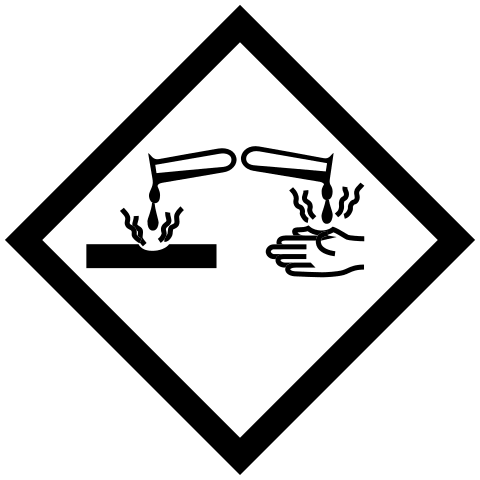 Corrosion |
| Precautionary statements: Prevention | Do not breathe mists. Wash hands and any exposed skin thoroughly after handling. Wear protective gloves, protective clothing, eye protection and face protection. |
| Response | If swallowed: Rinse mouth. Do NOT induce vomiting. If on skin (or hair): Take off immediately all contaminated clothing. Rinse skin with water or shower. Wash contaminated clothing before reuse. If inhaled: Remove person to fresh air and keep comfortable for breathing. If in eyes: Rinse cautiously with water for several minutes. Remove contact lenses, if present and easy to do. Continue rinsing. Immediately call a poison center or doctor. Specific treatment: see Section 4. |
| Storage | Store locked up. |
| Disposal | Dispose of contents and container in accordance with federal, state and local regulations (see Section 13). |
| Hazards not otherwise classified | None identified. |
| Hazards classified under 1910.1200(d)(1)(ii) (reaction products) | None for the recommended use. Mixing with bleach or other chlorine products forms toxic chloramine gases. |
| Ingredients of unknown acute toxicity | None. |
SECTION 3Composition/information on ingredients
Mixture (oil-in-water emulsion).
| Chemical name | Common name and synonyms | CAS No. or identifier | Concentration (wt %) |
|---|---|---|---|
| Ammonia | Ammonia, present as ammonium hydroxide (CAS 1336-21-6); added as 8% Polyjuice Base (25% solution) | 7664-41-7 | 2 |
| White mineral oil (petroleum) | Mineral oil; paraffin oil; liquid petrolatum | 8042-47-5 | 20 |
| Emulsifier blend ("Savvy") | Withheld as trade secret | Trade secret. Identifier: Perry Industries SV-1138 | 5 to 10 |
| Fragrance ("Essence of Brilliance") | Withheld as trade secret | Trade secret. Identifier: Perry Industries EB-0001 | 0.1 to 1 |
| Water | Water | 7732-18-5 | Balance (about 70) |
White mineral oil is listed because an OSHA PEL applies to its mist (Section 8). The specific chemical identities and exact concentrations of the emulsifier blend and fragrance have been withheld as trade secrets in accordance with 29 CFR 1910.1200(i); neither is classified as a health hazard at its concentration. Health professionals, employees and designated representatives may obtain the identities under 1910.1200(i) from the contact in Section 1.
SECTION 4First-aid measures
| Inhalation | Move the person to fresh air. Get medical attention if coughing, breathing difficulty or throat irritation develops. |
| Skin contact | Immediately flush skin with plenty of water for at least 15 minutes while removing contaminated clothing and shoes. Use the safety shower for large contact. Get medical attention. |
| Eye contact | Immediately flush with water for at least 15 minutes, holding eyelids open. Remove contact lenses if easy to do. Continue rinsing on the way to medical care. Get medical attention immediately. |
| Ingestion | Rinse mouth. Do NOT induce vomiting. If the person is conscious, give a small amount of water. Get medical attention immediately. |
| Most important symptoms and effects, acute and delayed | Skin burns; serious eye damage; burns of mouth and throat if swallowed. Ammonia odor can irritate the nose and throat in poorly ventilated areas. |
| Immediate medical attention and special treatment | Immediate medical attention is required for eye contact and ingestion. Alkali eye injuries need prolonged irrigation and an eye specialist. |
SECTION 5Fire-fighting measures
| Suitable extinguishing media | Product is a water-based emulsion and does not readily burn. Use media suitable for the surrounding fire: water spray, foam, dry chemical, carbon dioxide. |
| Unsuitable extinguishing media | None known. |
| Specific hazards | Heating drives off water and ammonia; the remaining oil residue is combustible. Combustion products: carbon monoxide, carbon dioxide, nitrogen oxides. |
| Special protective equipment and precautions for fire-fighters | Positive-pressure SCBA and structural fire-fighting gear. |
SECTION 6Accidental release measures
| Personal precautions, protective equipment and emergency procedures | Ventilate the area. Wear the PPE in Section 8, including goggles, face shield and chemical-resistant gloves and boots. Spilled product is slippery. Responders follow the employer's emergency response plan. |
| Methods and materials for containment and cleaning up | Stop the leak if it can be done safely. Dike and contain; keep out of storm drains, sewers and waterways. Absorb with inert absorbent and place in labeled containers. Wash the area with water and collect the wash water. |
| Release reporting | Oil: the product contains mineral oil. A discharge that causes a sheen or film on the surface of water must be reported to the National Response Center, 1-800-424-8802 (40 CFR 110.3 and 110.6). Ammonium hydroxide: the product is made with 8% ammonium hydroxide solution (Polyjuice Base). Counting that solution as added, a release of 12,500 lb or more of product in 24 hours reaches the 1,000 lb ammonium hydroxide RQ and must be reported to the National Response Center and to the SERC and LEPC (40 CFR 302.6; EPCRA 304). See Section 15. |
SECTION 7Handling and storage
| Precautions for safe handling | Use with good general ventilation. Do not get in eyes, on skin or on clothing. Keep containers closed. Wash hands after handling. Provide eyewash and safety shower (29 CFR 1910.151(c)). |
| Conditions for safe storage, including incompatibilities | Store in closed containers at room temperature. Protect from freezing and from temperatures that break the emulsion. Keep away from acids, bleach and other chlorine products, and strong oxidizers. Do not store in copper, brass or galvanized containers. |
SECTION 8Exposure controls/personal protection
Occupational exposure limits
| Ingredient (CAS) | OSHA PEL (Table Z-1) | NIOSH REL | ACGIH TLV | NIOSH IDLH |
|---|---|---|---|---|
| Ammonia (7664-41-7) | TWA 50 ppm (35 mg/m³) | TWA 25 ppm (18 mg/m³); STEL 35 ppm (27 mg/m³) | TWA 25 ppm; STEL 35 ppm | 300 ppm |
| White mineral oil (8042-47-5); limits are for oil mist, mineral (CAS 8012-95-1) | TWA 5 mg/m³ | TWA 5 mg/m³; STEL 10 mg/m³ | TWA 5 mg/m³, inhalable particulate matter (mineral oil, pure, highly and severely refined) | 2,500 mg/m³ |
| Emulsifier blend; fragrance (trade secret) | None established | None established | None established | None established |
| Appropriate engineering controls | General ventilation. Local exhaust where the product is sprayed or heated. Eyewash and safety shower in the work area. |
| Eye/face protection | Chemical splash goggles. Add a face shield where splashing is likely. |
| Skin protection | Chemical-resistant gloves (for example nitrile or neoprene), apron and boots. Confirm breakthrough time with the glove manufacturer's data. |
| Respiratory protection | Not normally needed with adequate ventilation. If ammonia or oil mist exceeds the limits above, use a NIOSH-approved respirator selected under a program meeting 29 CFR 1910.134. |
SECTION 9Physical and chemical properties
| Physical state | Liquid (emulsion) |
| Color | Milky white |
| Odor; odor threshold | Fragrance with an ammonia note. Odor threshold not determined (ammonia: mean detection 17 ppm). |
| Melting point/freezing point; boiling point | Not determined |
| Flammability; lower/upper flammability limit | Not classified as flammable. Flammability limits not determined. |
| Flash point | Not determined; water-based emulsion. White mineral oil ingredient: about 193 °C (380 °F), open cup. |
| Auto-ignition temperature; decomposition temperature | Not determined |
| pH | 11.6 (typical) |
| Kinematic viscosity | Not determined. White mineral oil ingredient: about 68 mm²/s at 40 °C. |
| Solubility | Dispersible in water |
| Partition coefficient n-octanol/water (log Kow) | Not applicable (mixture) |
| Vapor pressure; evaporation rate; relative vapor density | Not determined |
| Density/relative density | 0.98 g/mL at 20 °C; relative density 0.98 |
| Particle characteristics | Not applicable (liquid) |
SECTION 10Stability and reactivity
| Reactivity | Reacts with acids. Ammonia content corrodes copper, brass and zinc. |
| Chemical stability | Stable in closed containers. Emulsion can separate if frozen or overheated. |
| Possibility of hazardous reactions | Mixing with bleach (sodium hypochlorite) or other chlorine products forms toxic chloramine gases. |
| Conditions to avoid | Freezing, high heat, open containers. |
| Incompatible materials | Bleach and other halogen compounds, acids, strong oxidizers, copper, brass, zinc and galvanized metal. |
| Hazardous decomposition products | Ammonia on heating. Carbon monoxide, carbon dioxide and nitrogen oxides when burned. |
SECTION 11Toxicological information
| Likely routes of exposure | Skin and eye contact; inhalation of ammonia vapor or mist; ingestion. |
| Symptoms | Skin burns and serious eye damage; nose and throat irritation from ammonia vapor in poorly ventilated areas. |
| Acute toxicity (numerical measures) | Ingredient data: ammonium hydroxide oral LD50 (rat) 350 mg/kg. White mineral oil is not classified for acute toxicity; no numerical value is used in the calculation. Mixture ATE (oral, calculated, Appendix A.1.3.6): about 4,400 mg/kg, applying the ammonium hydroxide value to the 8% solution as added. Not classified for acute toxicity. |
| Skin corrosion/irritation | Category 1 (mixture pH 11.6, 29 CFR 1910.1200 Appendix A, A.2.3.1.3). |
| Serious eye damage/irritation | Category 1. In the absence of any other information, a mixture with pH 11.5 or higher is considered to cause serious eye damage (Appendix A, A.3.3.1.2). |
| Respiratory or skin sensitization; germ cell mutagenicity; reproductive toxicity; STOT repeated exposure | Not classified. |
| Specific target organ toxicity, single exposure | Not classified. Ammonia (respiratory tract irritant) at 2% is below the 20% concentration limit in Appendix A.8.3.4.5. |
| Aspiration hazard | Not classified. The white mineral oil has a kinematic viscosity of about 68 mm²/s at 40 °C, above the 20.5 mm²/s criterion in Table A.10.1, so it is not a Category 1 aspiration ingredient (Appendix A.10.3.3). |
| Delayed, immediate and chronic effects | Immediate: skin burns and eye damage. Chronic: prolonged skin contact with oil can cause dryness or dermatitis. |
| Interactive effects | No information available. |
| Carcinogenicity | White mineral oil (highly refined, NF/technical grade): IARC Group 3. NTP lists only untreated and mildly treated mineral oils, which do not include this grade. No ingredient is regulated by OSHA as a carcinogen. |
| Basis of classification (Table D.1, 11(g)) | The mixture has not been tested for toxicity. Skin and eye classification uses the measured mixture pH (A.2.3.1.3, A.3.3.1.2). Other endpoints use the ingredient concentration methods in Appendix A (A.1.3.6, A.8.3.4, A.10.3.3) and ingredient data. |
SECTION 12Ecological information
| Ecotoxicity | Product not tested. Ammonium hydroxide is very toxic to fish (bluegill LC50 0.024 to 0.093 mg/L, 48 h). White mineral oil: no data available. |
| Persistence and degradability | Ammonia is converted by nitrification. Mineral oil degrades slowly. |
| Bioaccumulative potential | No information available. |
| Mobility in soil | Oil phase has low mobility and adsorbs to soil. |
| Other adverse effects | Oil can form a sheen or film on water. |
SECTION 13Disposal considerations
Discarded unused product does not exhibit the corrosivity characteristic: the pH (11.6) is below the 12.5 limit in 40 CFR 261.22(a)(1), and it is not expected to be ignitable. The generator must still make a hazardous waste determination (40 CFR 262.11). No ingredient is a listed P or U waste. Do not discharge to storm drains or surface water; oil content can cause a reportable sheen. Recover or dispose of through a permitted facility in accordance with federal, state and local regulations.
SECTION 14Transport information
| DOT classification (49 CFR) | Not regulated as a hazardous material for transport, except a single package holding 12,500 lb or more of product (see Hazardous substance below). Class 8 not met by the 49 CFR 173.137(d)(2) calculation method (Class 8 ingredients 2%, below 5%); not Class 3 (no flash point to 93 °C). |
| UN number; proper shipping name; class; packing group | Not applicable (not regulated). For a package that holds the RQ: see Hazardous substance below. |
| Hazardous substance (49 CFR 171.8) | Ammonium hydroxide, RQ 1,000 lb (454 kg) per 40 CFR 302.4. The ammonium hydroxide solution is counted as the hazardous substance (Section 15): 8% of the product, above the 2% concentration for a 1,000 lb RQ in the 171.8 table. A single package holding 12,500 lb or more of product (a cargo tank) is a hazardous substance, shipped as Class 9 (173.140(b)): RQ, UN3082, Environmentally hazardous substance, liquid, n.o.s. (Ammonium hydroxide), 9, III. Emergency Response Guidebook Guide 171. |
| Environmental hazards | Not a marine pollutant. Appendix B to 172.101 lists ammonia solutions only above 10% ammonia, and the 25% solution added is 8% of the product, below the 10% concentration in the 171.8 definition. |
| Transport in bulk (IMO instruments) | No information available. |
| Special precautions | Keep from freezing. Do not load with acids or chlorine bleach products. |
SECTION 15Regulatory information
| TSCA | Ammonia, ammonium hydroxide and white mineral oil (petroleum): listed on the TSCA Inventory (active). Emulsifier blend and fragrance: TSCA status held by Perry Industries. |
| CERCLA (40 CFR 302.4) | Ammonium hydroxide (1336-21-6): RQ 1,000 lb (454 kg). Ammonia (7664-41-7): RQ 100 lb (45.4 kg). EPA guidance: releases of ammonium hydroxide solution are reported against the ammonium hydroxide RQ, without applying the mixture rule to the ammonia in the solution; free ammonia gas released is reported against the ammonia RQ. Product threshold, counting the 8% solution as added: 12,500 lb of product. Basis: EPA, "Determining the Amount Released for Ammonia and Ammonium Hydroxide for Release Notification Requirements under CERCLA Section 103 and EPCRA Section 304" (epa.gov/epcra). |
| Clean Water Act 311 (40 CFR 116.4) | Ammonia (7664-41-7) and ammonium hydroxide (1336-21-6) are designated hazardous substances under section 311 of the Clean Water Act; the designation includes solutions and mixtures (40 CFR 116.4; Table 302.4, statutory code 1). RQ: ammonium hydroxide 1,000 lb (454 kg); ammonia 100 lb (45.4 kg). |
| EPCRA 302/304 (40 CFR 355, Appendix A) | Ammonia is an extremely hazardous substance: TPQ 500 lb; RQ 100 lb. Ammonia at 2% (more than 1%) counts toward the TPQ: pounds of ammonia = 0.02 x pounds of product (40 CFR 355.13). |
| EPCRA 311/312 (40 CFR 370) | Hazardous chemical under the OSHA HCS. Ammonia (EHS): threshold 500 lb of ammonia (500 lb or the TPQ, whichever is lower, 40 CFR 370.10(a)(1)). Product as a hazardous chemical: 10,000 lb (40 CFR 370.10(a)(2)(i)). |
| EPCRA 313 (40 CFR 372.65) | Ammonia is listed; 10% of total aqueous ammonia is reportable under the listing. EPA's TRI guidance for ammonia applies the 1% de minimis to the total aqueous ammonia concentration; this product is 2%, so supplier notification applies (40 CFR 372.45). Supplier notification: This product contains a toxic chemical subject to the reporting requirements of section 313 of Title III of the Superfund Amendments and Reauthorization Act of 1986 and 40 CFR Part 372: Ammonia, CAS 7664-41-7, 2% by weight (total aqueous ammonia; 10% of total aqueous ammonia is reportable under the 40 CFR 372.65 listing). This notice must not be detached from this SDS. Any copying and redistribution of this SDS must include this notice. |
| Clean Air Act 112(r) (40 CFR 68.130) | Not covered. The listed substance is "Ammonia (conc 20% or greater)." |
| Clean Water Act 311 (40 CFR 110, 112) | White mineral oil is an oil under 40 CFR 112.2. Discharges of oil that cause a sheen are reportable (40 CFR 110.3, 110.6). |
SECTION 16Other information, including date of preparation or last revision
| Date of preparation or last revision | October 9, 2026. Version 4.0. Supersedes March 11, 2024. |
| Revision note | Section 2 classification and Section 14 updated. Prepared under the Hazard Communication Standard as amended May 20, 2024 (89 FR 44144) and corrected October 9, 2024 (89 FR 81829) and January 8, 2026 (91 FR 562). |
| Prepared by | Dana Scully, EHS Manager, Perry Industries, Inc., (555) 555-0104. |
| Abbreviations | ATE: acute toxicity estimate. EHS: extremely hazardous substance. NF: National Formulary. RQ: reportable quantity. TPQ: threshold planning quantity. |